
FAQS
Why Choose a Two Phase Heat Pipe for Global Sourcing?
Global electronics, battery, aerospace, and telecommunications markets demand smaller thermal solutions with dependable performance. MarketsandMarkets reported that the global thermal management market could grow from approximately USD 4.8 billion in 2023 to USD 9.2 billion by 2028. This growth reflects a practical problem: heat must move efficiently inside increasingly compact equipment.
A Two Phase Heat Pipe transfers heat through evaporation and condensation. It contains no mechanical pump. That reduces moving-part failures, energy consumption, and maintenance requirements. Dr. Amir Faghri, a leading heat-transfer researcher, describes a heat pipe as “a device that can transfer heat over considerable distances with a small temperature drop.” His statement captures the central sourcing advantage. A well-designed pipe can move heat from a crowded processor to a remote fin stack.
Yet global sourcing is not simply a price comparison. Suppliers must demonstrate wick structure control, vacuum integrity, thermal resistance, and repeatable filling processes. ISO 9001 certification helps, but it does not replace product-level testing. Buyers should request thermal cycling data, leak testing records, material declarations, and dimensional inspection results.
Details matter. A copper pipe may look identical across samples, while its internal wick differs significantly. That difference can affect startup temperature and long-term reliability. The choice is not automatically right. Poor design creates bottlenecks.
A disciplined sourcing process compares engineering support, tooling ownership, lead times, packaging, and regional logistics. It also evaluates second-source capacity. Lower cost may be attractive, but unstable quality becomes expensive quickly. This is where experienced technical review remains essential.
What Is a Two-Phase Heat Pipe?
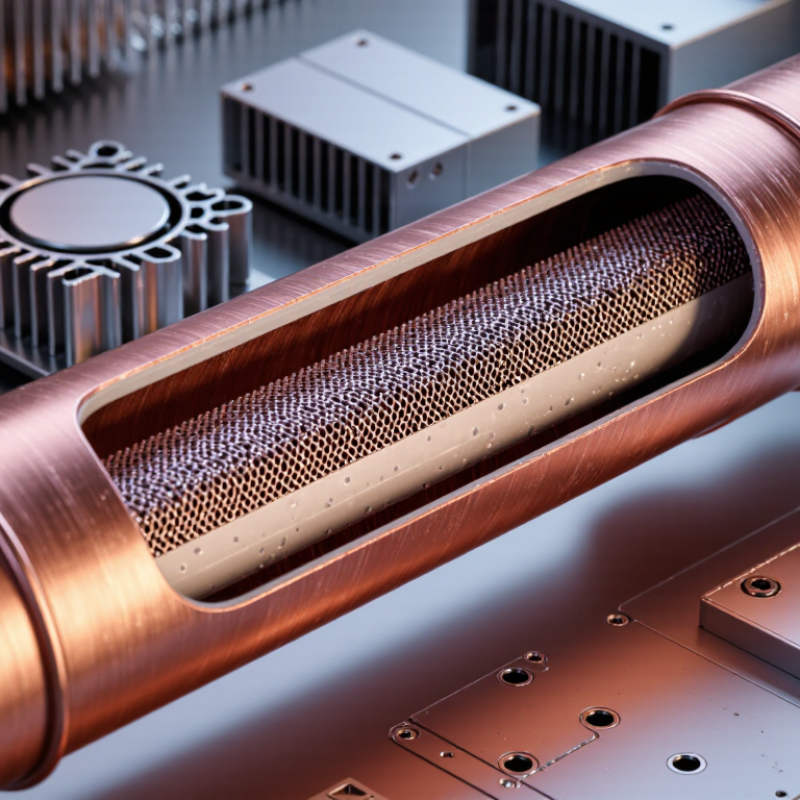
A two-phase heat pipe is a sealed thermal device using liquid and vapor. Inside, a working fluid absorbs heat at the evaporator. It changes into vapor, travels toward the cooler condenser, and releases heat through condensation. A porous wick then returns the liquid through capillary action. No mechanical pump is required.
The principle sounds simple. It is not. The wick structure, internal pressure, fluid charge, and orientation must match the application. A laptop module may use a thin copper envelope, while industrial equipment needs larger channels and stronger joints. NASA technical reports describe heat pipes as highly effective passive thermal-control devices, but performance can decline through dry-out, excessive heat flux, or poor installation.
The energy case is also practical. The International Energy Agency’s Electricity 2024 report estimates that data centres consumed about 460 TWh globally in 2022, with demand potentially exceeding 1,000 TWh by 2026. Cooling can represent a significant share of facility energy. The U.S. Department of Energy notes that cooling may account for up to 40% of data-centre electricity use. A passive two-phase heat pipe can reduce pump and fan requirements, though it cannot replace airflow design or accurate thermal testing.
For global sourcing, buyers should request thermal resistance data, operating-temperature limits, wick details, pressure-test records, and reliability results. Supplier documents are useful, but not always complete. Sample testing remains necessary. Sometimes, the smallest design change causes the largest thermal difference.
Why Choose a Two-Phase Heat Pipe for Global Sourcing?
What Is a Two-Phase Heat Pipe?
A two-phase heat pipe transfers heat through repeated evaporation and condensation. The chart compares the normal boiling points of common working fluids at 1 atmosphere. In an actual heat pipe, internal pressure is adjusted to match the required operating temperature, allowing efficient heat transport across different climates and applications.
How Two-Phase Heat Transfer Works
Why Choose a Two Phase Heat Pipe for Global Sourcing?
How Two-Phase Heat Transfer Works
A two-phase heat pipe moves heat through evaporation and condensation. At the hot end, a working fluid absorbs heat and becomes vapor. The vapor travels through a sealed tube toward a cooler section. It then condenses and releases heat through the wall. A wick returns the liquid by capillary action. No mechanical pump is required.
This cycle can transfer substantial heat within a compact structure. The International Energy Agency reported that data centers used about 460 TWh of electricity in 2022. Its Electricity 2024 report projects demand could reach 620–1,050 TWh by 2026. Cooling matters. U.S. Department of Energy guidance notes that cooling can represent up to 40% of data center electricity use.
In engineering reviews, two-phase heat pipes often simplify thermal paths around processors, batteries, and power modules. Their performance depends on fluid choice, wick design, fill ratio, and operating temperature. A poor match can cause dry-out or unstable startup. Orientation also matters, although some designs tolerate difficult mounting positions.
The design is not magic.
For global sourcing, buyers should request thermal resistance data, leak testing methods, cycle-life results, and material declarations. Independent laboratory reports are more useful than attractive catalog numbers. I would also question results measured only in ideal conditions. Real assemblies face vibration, dust, uneven contact, and changing ambient temperatures. These details can expose weaknesses before mass production begins.
Key Benefits for Thermal Management
Why Choose a Two Phase Heat Pipe for Global Sourcing?
Key Benefits for Thermal Management
A two phase heat pipe moves heat through evaporation and condensation inside a sealed tube. Its working fluid absorbs heat near the source, then releases it through a cooler condenser section. This passive cycle can reduce hot spots without pumps, motors, or complex controls. That matters. In compact electronics, a small copper pipe can connect a processor area to a remote cooling surface. The result is often lower thermal resistance and quieter operation.
For global sourcing, the design also supports flexible manufacturing and easier system integration. Suppliers can provide different lengths, diameters, bends, and mounting structures for regional production needs. Engineers should request thermal performance curves, leak-testing records, material details, and dimensional inspection data. Reliable validation includes tests at expected power levels, orientations, ambient temperatures, and vibration conditions. A heat pipe may perform well in a laboratory but behave differently inside a crowded cabinet. Still, details matter.
I would not treat this technology as a universal fix. Wick structure, fill ratio, gravity direction, and condenser contact can affect performance significantly. Poor interface pressure may create a surprising temperature rise. Procurement teams should compare samples from multiple qualified suppliers and repeat tests after transport simulation. Clear drawings and traceable quality records reduce misunderstandings across languages, factories, and time zones. Small oversights remain possible, even with careful engineering.
Why Choose a Two Phase Heat Pipe for Global Sourcing? - Key Benefits for Thermal Management
| Evaluation Dimension | Two Phase Heat Pipe Capability | Typical Reference Data | Global Sourcing Benefit |
|---|---|---|---|
| Heat Transfer Efficiency | Transfers heat through evaporation, vapor movement, condensation, and capillary return of the working fluid. | Effective thermal conductivity is commonly reported in the approximate range of 10,000–100,000 W/m·K, depending on geometry, working fluid, wick structure, and operating temperature. | Enables compact thermal designs and can reduce the amount of solid metal required for heat spreading. |
| Passive Operation | Operates without an electric pump, fan, or external power supply. | Heat transfer is driven by phase change and pressure differences inside a sealed pipe. | Reduces auxiliary power consumption, noise, moving-part count, and maintenance requirements. |
| Heat Spreading Distance | Moves heat from a concentrated source to a remote condenser or larger dissipation area. | Heat transport distance is application-specific; standard assemblies are often designed for lengths from several centimeters to more than one meter. | Supports flexible placement of heat sources and heat sinks in electronics, battery systems, lighting, and industrial equipment. |
| Operating Orientation | Performance depends on wick type, internal structure, heat load, and the direction of gravity. | Sintered and grooved wick designs can support operation against gravity; actual limits must be verified by thermal testing. | Allows thermal solutions to be selected for fixed, tilted, rotating, or mobile equipment when orientation requirements are defined early. |
| Temperature Capability | Can be engineered for different temperature zones by matching the working fluid, envelope material, and wick structure. | Common water-based copper heat pipes are generally used around 30–150°C; the final operating range depends on the design and application. | Makes it possible to source one thermal technology for multiple product platforms with different temperature requirements. |
| Heat Load Flexibility | Can be manufactured as straight pipes, flattened pipes, vapor chambers, or shaped assemblies. | Heat transport capacity varies widely, from a few watts in small electronic assemblies to hundreds of watts or more in larger engineered systems. | Provides a scalable platform for different product sizes, power levels, and enclosure constraints. |
| Space and Weight Optimization | Moves heat efficiently through thin or narrow profiles while separating the heat source from the heat rejection area. | Typical flattened heat pipes can be produced in thin profiles, with thickness selected according to required heat load and mechanical constraints. | Helps meet compact enclosure, low-profile, and weight-reduction targets without adding active cooling hardware. |
| Reliability and Maintenance | A sealed heat pipe has no internal mechanical moving parts and normally requires no service during its intended life. | Reliability depends on leak-tight sealing, material compatibility, cleanliness, structural protection, and correct operating conditions. | Simplifies maintenance planning and can improve product availability in remote or difficult-to-service installations. |
| Material and Fluid Selection | Copper/water, aluminum/ammonia, and other material-fluid combinations are selected according to temperature and compatibility requirements. | Copper/water combinations are widely used for moderate-temperature electronics; material compatibility must be validated for every design. | Creates sourcing flexibility across different climates, industries, regulatory environments, and application temperatures. |
| Quality Control Requirements | Requires controlled filling, vacuum processing, sealing, dimensional inspection, and thermal performance verification. | Recommended checks include leak testing, visual inspection, cleanliness control, temperature cycling, and sample heat-load testing. | A clear inspection specification improves supplier comparison and reduces quality variation across international production locations. |
| Total Cost Consideration | The component cost must be evaluated together with assembly, power consumption, maintenance, enclosure space, and system-level cooling requirements. | Cost varies with material, diameter, length, wick structure, forming process, tolerance, testing, and annual volume. | Enables a total-cost comparison rather than judging the thermal component by purchase price alone. |
Note: Performance values are representative engineering ranges rather than guaranteed specifications. Final heat transport capacity, temperature range, orientation limit, and service life should be confirmed through application-specific design and testing.
Factors to Assess During Global Sourcing
Why Choose a Two Phase Heat Pipe for Global Sourcing?
Factors to Assess During Global Sourcing
A two phase heat pipe transfers heat through evaporation and condensation inside a sealed tube. Its design can reduce fan noise, energy use, and local hot spots. During global sourcing, begin with the actual thermal load, not a catalogue rating. Record heat output, operating temperature, installation angle, and available space. A unit rated for 80 watts may perform differently inside a restricted enclosure.
Small details matter. Check tube diameter, length, wick structure, working fluid, and material compatibility. The working fluid must suit the expected temperature range. Confirm that soldering, brazing, or welding methods match your corrosion and pressure requirements. Ask for thermal resistance data from controlled tests. Test reports should identify conditions, instruments, and measurement uncertainty. Vague curves create expensive surprises.
Supplier capability deserves equal attention. Review process controls, leak testing, cleanliness standards, traceability, and change-management procedures. Request production samples rather than relying only on drawings. Samples expose assumptions. In practical sourcing work, a small bend-radius mistake has caused installation delays. I have also seen excellent prototypes fail because packaging allowed tube deformation during transport. Assess inspection records, capacity during peak demand, communication speed, and realistic lead times. Local regulations, customs documentation, and material declarations should be verified before purchase. A specification can still be wrong. Recheck it against the final assembly, especially after any design change.
Applications and Selection Considerations
Why Choose a Two Phase Heat Pipe for Global Sourcing?
A two-phase heat pipe transfers heat through evaporation and condensation inside a sealed tube. It can move heat efficiently without pumps, motors, or external power. This makes it useful for LED lighting, battery modules, telecom cabinets, medical instruments, and compact industrial electronics. In a crowded enclosure, a heat pipe can carry heat from a processor to a remote fin stack. The surface stays cooler.
Selection should begin with the real operating conditions. Measure heat load, source temperature, target temperature, available length, and installation angle. Orientation matters. Some designs lose performance when gravity works against liquid return. Working-fluid compatibility also matters across the full temperature range. Copper tubes suit many electronics, but material choices must match corrosion risks and assembly requirements. Wick structure affects start-up, capillary return, and maximum heat transport. A small prototype can reveal problems that a specification sheet misses.
Global sourcing adds practical checks. Request thermal test data, vacuum retention results, dimensional tolerances, and traceable inspection records. Ask how suppliers control cleanliness, charging quantity, sealing, and leak testing. Packaging deserves attention too; bent tubes or crushed fins may arrive after a perfect factory test. I have seen teams select by price alone, then discover poor performance during cold starts. That shortcut is expensive. A supplier should provide samples, test methods, and clear acceptance limits before volume production. Some uncertainty remains, especially when field airflow differs from laboratory conditions.
Skip to content
