FAQS
How to Choose the Best Garden Heater for Your Outdoor Space
Choosing the best garden heater begins with more than comparing prices, wattage, and stylish finishes. Your outdoor space may be a compact balcony, a stone patio, or a windy terrace. Each setting changes the heater’s performance, comfort, and safety requirements. A tall infrared model may warm seated guests efficiently, while a portable gas heater may suit larger, open areas. The right choice depends on real conditions.
Energy use also deserves close attention. The 2024 Global Status Report for Buildings and Construction, published by UNEP and the GlobalABC, reports that buildings consume about 34% of global energy. This broader figure highlights why efficient outdoor heating should not be treated as an afterthought. Look for adjustable heat settings, targeted infrared technology, timers, and strong weather resistance. A lower purchase price can become expensive when used frequently.
Safety must remain central. The National Fire Protection Association reports that heating equipment caused an average of 48,530 reported home fires annually between 2016 and 2020 in the United States. Outdoor equipment still needs stable placement, clearances, and careful fuel management. The U.S. Consumer Product Safety Commission also warns about carbon monoxide risks from fuel-burning appliances. Never use a gas garden heater in an enclosed area.
Small details matter. Measure the seating zone, check wind exposure, and inspect the power supply first. I have found that many buying guides oversimplify this decision. They often ignore glare, noise, storage, and uneven warmth. No heater is perfect. This guide helps you compare those compromises with practical evidence, not attractive product claims alone.
Define Space and Exposure: Compare 1,500 W and 40,000 BTU/h Outputs
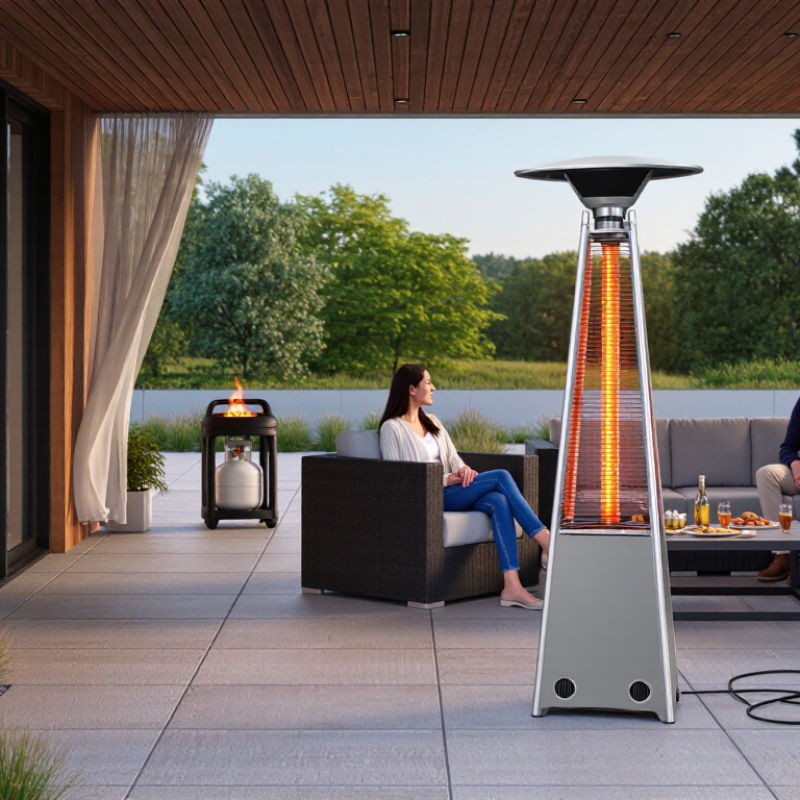
Choosing the best garden heater starts with your space, not the biggest number on the label. A 1,500 W electric heater suits a small patio, balcony, or sheltered dining area. It delivers focused radiant warmth, especially when mounted near seated guests. At 120 volts, it may draw about 12.5 amps, so the circuit deserves careful attention. Do not ignore that detail.
A 40,000 BTU/h heater produces roughly 11.7 kW of heat, nearly eight times the output of 1,500 W. It can serve a larger, open seating area, but wind quickly carries warmth away. Measure the space first. Note the ceiling height, open sides, and usual wind direction. A covered patio with three walls needs less output than an exposed deck. More power is not automatically better.
I once assumed a high-output heater would solve every cold evening. It did not. Strong drafts reduced comfort, while nearby guests became too warm. A lower-output unit worked better after we changed its position. Check the manufacturer’s clearance requirements, fuel arrangement, and ventilation needs. For electric models, inspect cable length and circuit capacity. For fuel-burning models, allow safe airflow and stable placement. Your actual comfort may depend more on exposure and positioning than rated output.
Compare Running Costs Using Local Electricity and LPG Prices
How to Choose the Best Garden Heater for Your Outdoor Space
Running cost matters more than a heater’s impressive heat output. Measure your seating area first. A small patio may need focused warmth, not a powerful unit. Electric heaters are simple to operate and usually require less maintenance. Their hourly cost is easy to calculate: heater power in kilowatts multiplied by your local electricity price.
LPG heaters can warm larger spaces, but their cost depends on local LPG prices and gas consumption. Check the appliance label for kilograms used per hour. Then multiply that figure by your local price per kilogram. My first comparison was misleading because I compared maximum heat settings. A lower setting often provides enough comfort and reduces fuel use. Real performance also changes with wind, temperature, and seating distance. Use outdoor-rated equipment and follow the supplied ventilation and storage guidance.
Tips:
Record your local prices before buying. Test both heaters for thirty minutes. Note warmth, noise, and fuel use. Ask a qualified installer to check LPG connections. Also compare refill fees, cylinder deposits, and electricity standing charges when relevant. These small costs are easy to overlook. They may change the cheaper option.
Assess Weather Resistance with IEC 60529 IP Ratings
How to Choose the Best Garden Heater for Your Outdoor Space
For a covered patio, an IP44 heater may resist splashing water from different directions. An IP65 model is dust-tight and can withstand water jets, making it more suitable for exposed areas. IP67 adds temporary immersion protection, though that does not mean the heater should sit in puddles. Check the exact test conditions. Real gardens are messier.
I have seen moisture collect around cable entries after cold nights. Good seals help, but correct installation matters just as much. Keep the unit above standing water, protect connections, and avoid directing sprinklers toward it. Inspect the housing after storms. Small cracks can become serious.
IP ratings do not measure heat performance, ultraviolet resistance, corrosion, or wind stability. A heater may have excellent water protection yet develop rust near the mounting bracket. Look for corrosion-resistant materials and firm support. Also confirm that the electrical supply and residual-current protection suit local regulations. I would not rely on a high IP number alone. It is useful evidence, not a complete safety assessment.
Verify Gas Safety Through ANSI Z83.26/CSA 2.37 Certification
How to Choose the Best Garden Heater for Your Outdoor Space
A warm patio should never depend on appearance alone. Verify gas safety through ANSI Z83.26/CSA 2.37 certification before comparing heat output, finish, or price. This standard covers gas-fired outdoor infrared patio heaters and evaluates key safety and performance requirements. Look for a permanent certification mark, the exact model number, approved gas type, and operating instructions. A vague “tested” statement is not enough.
The NFPA Home Heating Fires report estimates that U.S. fire departments responded to 48,530 heating-equipment fires each year from 2016 to 2020. These incidents caused about 500 civilian deaths, 1,350 injuries, and 1.1 billion dollars in annual direct property damage. The figures cover many heating products, not only patio heaters. Still, they show why certification and installation deserve attention. A certification mark is not a permission slip. Outdoor placement, ventilation, clearance, and hose condition still matter. I would not trust a heater simply because its flame looks stable.
Tips: Photograph the certification label before buying. Match the gas type and pressure with your supply. Keep the heater away from awnings, curtains, furniture, and low branches. Never use an outdoor gas heater inside an enclosed room. Check the manual for minimum clearances, then ask a qualified gas professional to review the setup. Small details matter.
| Heater Type | Typical Energy Source | Typical Heat Output | Suitable Outdoor Area | Fuel or Power Considerations | ANSI Z83.26/CSA 2.37 Relevance | Key Safety Features to Confirm | Best Use Case |
|---|---|---|---|---|---|---|---|
| Freestanding Gas Patio Heater | Liquid propane or natural gas | Approximately 30,000–50,000 BTU/h, depending on the model | Commonly suitable for a seating or dining zone of about 100–200 sq. ft.; actual coverage depends on wind, temperature, and heater design | Propane models are portable but require cylinder storage and replacement. Natural-gas models need a permanent, code-compliant connection. | Yes. Confirm that the specific gas appliance is certified and marked to ANSI Z83.26/CSA 2.37 by an accredited certification organization. | Flame-failure shutoff, properly rated hose and regulator, tip-over protection where provided, stable base, approved gas connector, and manufacturer-specified clearances | Heating a patio, terrace, or outdoor dining area where overhead clearance and ventilation are adequate |
| Wall-Mounted Gas Heater | Natural gas or liquid propane | Approximately 20,000–40,000 BTU/h | Usually intended for a defined zone near the mounting wall; coverage varies substantially with mounting height and wind exposure | Requires a suitable wall structure and a gas supply installed in accordance with local regulations. It is less flexible after installation. | Yes. Gas-fired outdoor models should have an applicable ANSI Z83.26/CSA 2.37 certification and product marking. | Secure mounting hardware, flame-failure protection, correct venting or outdoor-use design, protected gas piping, and required side and overhead clearances | Permanent patios, restaurants, covered outdoor areas, and spaces where floor space is limited |
| Ceiling-Mounted Gas Heater | Natural gas or liquid propane | Approximately 30,000–60,000 BTU/h, depending on design | Can heat a larger defined zone when correctly positioned, but performance is strongly affected by ceiling height, enclosure, and airflow | Installation is normally permanent and may require professional gas, structural, and ventilation work. | Yes. Verify the appliance certification, gas type, installation category, and required clearances before purchase. | Structural suspension, flame supervision, safe ignition, approved gas line, ventilation requirements, and clearance from combustible materials | Large covered patios or commercial outdoor spaces with suitable structural support |
| Portable Gas Fire Pit or Table | Liquid propane or natural gas | Approximately 30,000–60,000 BTU/h | Primarily provides localized radiant heat around the table or fire feature rather than uniform whole-area heating | Propane offers portability. Natural-gas versions require a fixed connection. Decorative media must be approved for the appliance. | Often applicable to gas-fired outdoor decorative appliances. Confirm the exact certification scope and marking for the model. | Flame-failure device, controlled ignition, gas shutoff, stable placement, approved fire media, wind protection, and clearance from combustible surfaces | Social seating areas where visual appeal and localized warmth are equally important |
| Electric Infrared Heater | Electricity | Commonly 1,500–3,200 W, equivalent to roughly 5,100–10,900 BTU/h | Usually heats a smaller personal or seating zone; radiant performance is directional and depends on mounting position | Produces no on-site combustion emissions, but requires an appropriately rated circuit, weather-resistant connection, and suitable outdoor electrical protection. | Not applicable because it is not gas-fired. Check for applicable electrical safety certification and an outdoor-use rating instead. | Ground-fault protection where required, weather-resistant enclosure, correct plug and circuit rating, secure mounting, and protection from water intrusion | Balconies, covered patios, and locations where gas storage or combustion ventilation is unsuitable |
| Natural-Gas Radiant Tube Heater | Natural gas; some configurations may use propane | Approximately 50,000–150,000 BTU/h, depending on length and installation | Designed for larger or elongated outdoor areas; heat distribution depends on tube layout, reflector design, and mounting height | Requires professional installation, permanent gas piping, adequate combustion air, and compliance with local building and fuel-gas codes. | Gas-fired outdoor units should be evaluated and marked under the applicable ANSI Z83.26/CSA 2.37 requirements when covered by the standard. | Flame supervision, safe ignition, gas-pressure controls, approved suspension, combustion-air provisions, exhaust considerations, and specified clearances | Large commercial terraces, hospitality areas, and permanently designed outdoor installations |
Evaluate Stability Features, Tip-Over Protection, and Timer Controls
Choosing the best garden heater begins with stability, not appearance. A tall heater should have a broad, weighted base that stays firm on paving, decking, or compact soil. Test it gently before use. If it wobbles beside a table, wind may worsen the problem.
Tip-over protection is essential. Look for a heater that switches off automatically when tilted or knocked over. This feature should work quickly, but never treat it as a replacement for supervision. Keep chairs, cushions, and dry leaves away from the heating area. I once underestimated how easily a loose outdoor mat could catch a stand. That mistake changed how I check the ground.
Timer controls add another layer of practical safety. Choose clear settings that allow short operating periods, such as one or two hours. A timer can prevent a heater from running after guests leave or while everyone sleeps. Test the control before relying on it. Some displays are difficult to read in evening light, and that small flaw matters. Place the control where you can reach it without stretching across hot surfaces. For extra reliability, inspect the base, switch, and power connection before each use. Weather changes quickly, and yesterday’s secure setup may not suit tonight’s wind.
How to Choose the Best Garden Heater for Your Outdoor Space
Compare three practical safety factors when evaluating outdoor heaters: base stability, tip-over protection, and timer controls.
Scores use a five-point selection checklist: 5 indicates the strongest practical safety specification to look for, while 1 indicates limited protection or control. Choose a heater with a wide, stable base, automatic shut-off if tipped, and a timer that can limit operating time when the space is unattended.
Related Posts
-
Why Choose the Best Gazebo Heater for Your Outdoor Comfort?
-
How to Choose the Best Garden Heater for Your Outdoor Space?
-
How to Choose the Best Garden Heater for Your Outdoor Space?
-
Exploring Innovations in Gas Patio Heater Products at the 2025 Canton Fair
-
Best Gas Patio Heater Options for Your Outdoor Space?
-
Best Gas Patio Heater Reviews and Buying Guide 2026?
Skip to content