How to Choose an Infrared Shop Heater for Your Business?
Choosing an infrared shop heater is not simply a matter of buying the highest-rated unit. A busy workshop may have open doors, tall ceilings, metal benches, vehicle lifts, and cold concrete floors. Each detail changes how warmth is delivered. An infrared shop heater warms people, tools, and surfaces directly, rather than heating every cubic metre of air first.
Building-science educator Robert Bean explains, “Thermal comfort is a human response to the thermal environment, not merely a thermostat reading.” That idea matters in commercial spaces. A worker standing beneath a well-positioned heater may feel comfortable while the far corner remains cold. Therefore, this guide examines heating zones, mounting height, wattage, beam direction, controls, and operating costs. It also considers dust, moisture, ventilation, and manufacturer safety instructions.
There is no perfect heater.
A reliable choice begins with the building, not the product photograph. Measure the floor area and ceiling height. Note large doors that open frequently. Check whether shelving or equipment blocks the radiant path. A powerful unit can still perform poorly when mounted too high or aimed at an empty wall. That mistake is easy to make.
The following outline helps business owners compare infrared shop heater designs with clearer expectations. It balances comfort, efficiency, installation practicality, and long-term maintenance. It also leaves room for honest uncertainty. Energy savings depend on usage, insulation, local climate, and control habits. Product claims should be checked against technical specifications, professional installation advice, and applicable safety requirements.
Assess Heat Loss with ASHRAE Fundamentals, Not Floor Area Alone
Choosing an infrared shop heater should begin with heat loss, not floor area alone. A 10,000-square-foot workshop may need less heat than a smaller building with open loading doors. ASHRAE Fundamentals provides established methods for estimating transmission loss, infiltration, ventilation, and outdoor design conditions.
Inspect the building envelope carefully. Thin roof panels, uninsulated walls, and a cold concrete slab can draw heat away continuously. A frequently opened forklift door may introduce more cold air than several small windows. I once assumed ceiling height mattered most, but repeated door openings changed the calculation significantly. That mistake was useful. It showed why site observations must support the calculation.
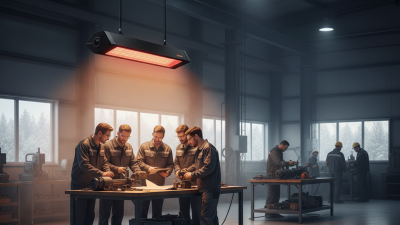
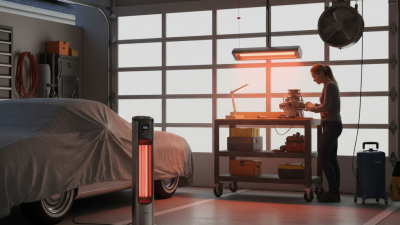
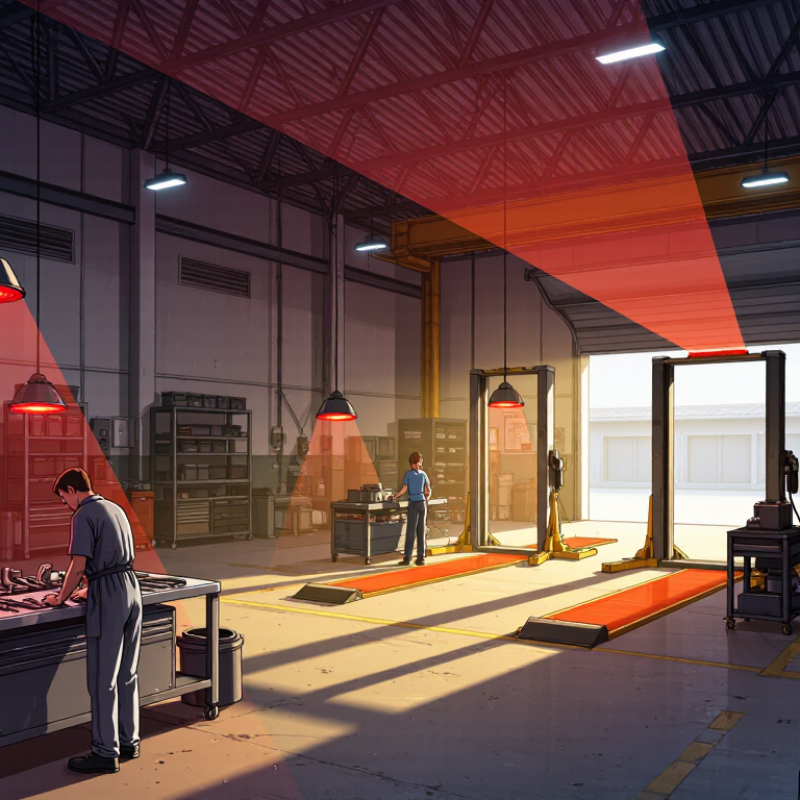
Infrared heaters warm people, tools, floors, and equipment directly. They do not simply raise the entire air volume. Place units above occupied work zones, benches, or assembly lines, while considering mounting height and shadowed areas. A qualified heating professional can compare calculated losses with the heater’s output and zoning requirements.
Tips: Record door-opening frequency, indoor temperature, insulation condition, and local winter design data. Check whether workers stand beneath the radiant pattern or outside it. Avoid sizing from wattage charts alone. ASHRAE guidance is valuable, but real buildings remain imperfect. Recheck assumptions after installation. A cold corner or uncomfortable workstation may reveal a missed air leak.
Size Output: 1 kW Delivers About 3,412 Btu/h of Heat
Choosing an infrared shop heater starts with its heat output, not its advertised coverage. One kilowatt delivers about 3,412 Btu/h, based on the U.S. Department of Energy’s standard energy conversion. That figure describes energy released, not guaranteed comfort. A 6 kW heater therefore provides roughly 20,472 Btu/h.
The room still matters.
ASHRAE Handbook guidance treats heat loss as a combination of transmission, infiltration, ventilation, and internal gains. A workshop with a frequently opened 12-foot door can lose heat quickly, even with strong radiant output. Cold concrete floors and uninsulated metal walls create another challenge. Infrared energy warms people, tools, and nearby surfaces directly, while air temperature may remain lower.
Measure before purchasing. Record floor area, ceiling height, insulation quality, door-opening frequency, and the required indoor temperature. Then compare the estimated heat loss with the heater’s total kilowatt output. Do not size by square footage alone. That shortcut can mislead.
In practical use, a 2 kW unit may suit a focused workbench, but a large open bay may need several evenly spaced units. The U.S. Department of Energy notes that radiant heating can reduce perceived comfort requirements in certain applications. However, airflow, mounting height, and clearances affect results. I would leave a modest capacity margin, rather than oversizing aggressively. Too much output can create hot faces, uneven floors, and unnecessary cycling. Performance also deserves checking after installation, because real workshops rarely behave like clean calculation sheets.
Compare Running Costs Using DOE’s Nearly 100% Point-of-Use Efficiency
How to Choose an Infrared Shop Heater for Your Business?
Running cost deserves more attention than the purchase price. The U.S. Department of Energy recognizes electric resistance heating as nearly 100% efficient at the point of use. Nearly all supplied electricity becomes heat inside the shop. That sounds simple, but it does not make every system equally affordable. Your utility rate, operating schedule, ceiling height, and insulation still control the final bill.
Use this calculation: heater kilowatts multiplied by operating hours and electricity price. A 6 kW heater running eight hours daily uses 48 kWh. Multiply that figure by your local rate, then compare it with fuel costs, delivery charges, and maintenance.
Infrared heat can warm people, workbenches, and machinery directly. That may reduce warm-up time in a large, drafty workspace. Heat moves. Comfort can improve before the entire air volume reaches the target temperature.
Walk through the shop during a normal shift. Notice cold floors, open doors, and inactive corners. A ceiling-mounted unit may suit a production area, while a smaller zone heater may fit a service counter.
Controls also matter. Timers, thermostats, and occupancy settings prevent needless runtime. I would not rely on efficiency claims alone. A poorly positioned heater can waste energy, despite excellent point-of-use performance. Measure actual hours and costs for one month. Then adjust honestly.
Check Power: A 2 kW Heater Draws 8.7 A on a 230 V Circuit
How to Choose an Infrared Shop Heater for Your Business?
Check power before comparing heating coverage. A 2 kW heater draws about 8.7 A on a 230 V circuit. The calculation is simple: 2,000 watts divided by 230 volts. That figure helps you judge whether the existing circuit can handle the heater safely. It does not tell the whole story. Other equipment may share the same circuit, including compressors, lights, or battery chargers. Their combined demand can trip the breaker or heat an undersized cable.
Measure the circuit.
Look at the breaker rating, cable condition, socket temperature, and installation history. A qualified electrician should verify the circuit before regular commercial use. A heater near its maximum load may operate for hours, especially in a cold workshop. Thermostatic cycling can reduce average consumption, but the heater still needs its full operating current when energized. Extension leads deserve caution. Long, thin cables can create voltage drop and unwanted heat.
Choose placement as carefully as power. Infrared heat warms people, benches, and machinery directly, so mounting height and line of sight affect comfort. Dust, high ceilings, open doors, and poor insulation can reduce practical performance. I would not select a heater from wattage alone. A 2 kW unit may suit one workstation but waste energy in an empty corner. Check actual work patterns, then allow a modest safety margin. My first estimate may still be wrong after winter arrives. Review energy readings and worker comfort, and adjust the layout rather than simply adding more heaters.
How to Choose an Infrared Shop Heater for Your Business? — Check Power: A 2 kW Heater Draws 8.7 A on a 230 V Circuit
| Rated Power |
Supply Voltage |
Approx. Current Draw |
Energy Use per Hour |
Typical Business Application |
Electrical Planning Point |
| 1.0 kW |
230 V AC |
4.35 A |
1.0 kWh |
Small workstation, reception area, or localized supplementary heat |
Suitable for a lower-load circuit, subject to local electrical requirements |
| 1.5 kW |
230 V AC |
6.52 A |
1.5 kWh |
Single work zone, compact retail area, or small service counter |
Check the heater plug, branch-circuit rating, and other connected loads |
| 2.0 kW |
230 V AC |
8.70 A |
2.0 kWh |
Medium-sized work area or targeted heating in a shop or workshop |
Current is calculated as 2,000 W ÷ 230 V; avoid overloading a shared circuit |
| 2.4 kW |
230 V AC |
10.43 A |
2.4 kWh |
Work areas requiring stronger spot heating or longer heat reach |
Verify circuit capacity, protective-device rating, and installation method |
| 3.0 kW |
230 V AC |
13.04 A |
3.0 kWh |
Larger workshop zones, loading areas, or high-heat-demand workstations |
Often requires careful circuit assessment and may need a dedicated supply |
| 4.0 kW |
230 V AC |
17.39 A |
4.0 kWh |
Large commercial zones or multiple targeted heating positions |
Use professional electrical design; confirm cable, protection, and isolator requirements |
|
Calculation and safety note:
Approximate current is calculated using the resistive-load formula
Current (A) = Power (W) ÷ Voltage (V).
Actual installation requirements depend on local electrical codes, circuit length, ambient conditions, plug configuration, and other connected equipment. Have the supply checked by a qualified electrician before installation.
|
Set Comfort and Safety Limits with ISO 7730 and IEC 60529 IP Ratings
Choosing an infrared shop heater is not only a wattage decision. It is a comfort and safety exercise.
ISO 7730 uses PMV and PPD to evaluate thermal comfort. A common design target is PMV between -0.5 and +0.5, with fewer than 10% dissatisfied occupants. Infrared heating changes mean radiant temperature, so air temperature alone can mislead. A worker beside a loading door may still feel cold, even when a wall thermometer shows 20°C. Measure occupied zones, walking routes, and workstations. Short tests matter.
Do not ignore local discomfort. Strong radiant differences, warm ceilings, or cold floors can reduce comfort under ISO 7730. My first estimate would not be final. Recheck conditions during door openings and peak work periods. The International Energy Agency reports that buildings consume about 30% of global final energy, making targeted heating worth examining. IEC 60529 then helps define enclosure protection. IP54 offers limited dust ingress protection and resistance to water splashes. IP65 provides dust-tight protection and resistance to water jets. Select the rating from real exposure, not appearance. A clean showroom proves little. Confirm installation height, cleaning methods, moisture, and dust conditions with the supplier and a qualified electrician.
How to Choose an Infrared Shop Heater for Your Business?
Use ISO 7730 comfort categories to set indoor comfort limits and IEC 60529 IP ratings to match the heater enclosure with the surrounding moisture conditions.
Comfort guidance: ISO 7730 defines Category A as the tightest thermal comfort range, with a predicted percentage of dissatisfied occupants below 6%. Categories B and C allow below 10% and 15%, respectively. These limits support heater sizing and thermostat planning, but actual comfort also depends on air movement, clothing, activity, humidity, and radiant temperature.
Safety guidance: Under IEC 60529, the second character in an IP code indicates water protection. IPX4 protects against splashing water, IPX5 against water jets, and IPX6 against powerful water jets. Select the rating according to the installation environment and follow the heater manufacturer's installation requirements.