
FAQS

How to Choose an Indoor Trampoline Park Manufacturer?

Choosing an indoor trampoline park manufacturer is not simply a matter of comparing prices or counting attractions. It is a decision about safety, visitor flow, maintenance, and long-term business performance. In Indoor Trampoline Park Design Manufacturing, small details can shape the entire customer experience. A weak layout may create crowded landing zones, confusing routes, or unnecessary staff pressure.

Jeff Platt, former CEO of Sky Zone, once said, “We are in the business of making people happy.” That idea deserves practical attention. Happiness in a trampoline park often begins with clean equipment, visible supervision, comfortable waiting areas, and attractions that match different age groups. It also depends on dependable materials, clear installation standards, and responsive after-sales support.

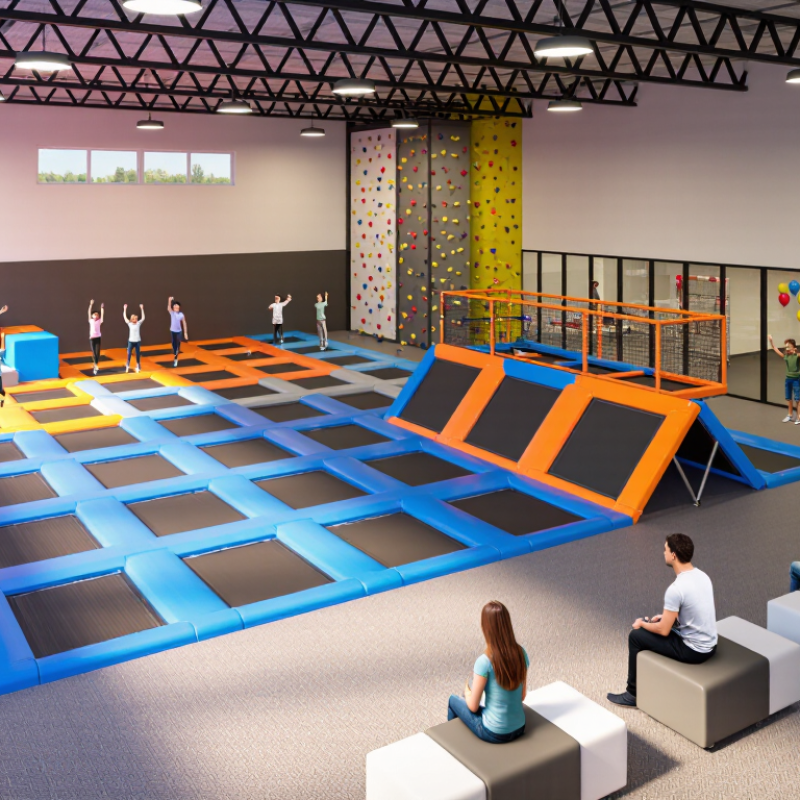
A strong manufacturer should provide more than colorful renderings. Ask for engineering details, production experience, testing procedures, installation records, and maintenance guidance. Visit completed projects if possible. Watch how guests move between trampolines, foam pits, climbing features, and party rooms. The best design may look less dramatic on paper, yet perform better every day.

There is no perfect manufacturer. Even experienced suppliers can miss a local operational challenge. That is why careful questioning matters. Discuss capacity, cleaning routines, replacement parts, staff training, and future expansion before signing an agreement. A thoughtful selection process reduces costly surprises and helps create a park that feels exciting, controlled, and trustworthy.
How to Choose an Indoor Trampoline Park Manufacturer?

Define Park Requirements Against ASTM F2970-17 and EN 13219 Safety Standards

How to Choose an Indoor Trampoline Park Manufacturer?

Choosing an indoor trampoline park manufacturer starts with clear safety requirements. Define the park layout, user ages, jump zones, platforms, foam pits, and emergency routes. Then compare each requirement with ASTM F2970-17 and EN 13219. These standards address different equipment and safety considerations, so one certificate cannot prove complete compliance. Ask the manufacturer for current test reports, engineering drawings, material specifications, and installation procedures. Check whether the documents match your exact model, not a similar product.

Inspect the details that visitors rarely notice. Look for continuous padding, secure frame connections, controlled gaps, stable anchors, and durable jumping surfaces. Request evidence of impact testing and load testing. Review cleaning access, replacement parts, inspection intervals, and staff training materials. A reliable supplier should explain how risks are managed during design, installation, daily operation, and maintenance. Local building and fire requirements must also be checked by qualified professionals.

Tips: Walk through a completed facility before signing. Watch how staff inspect springs, seams, netting, and padding. Ask to see inspection logs, not only photographs. Test the supplier with difficult questions. A checklist can still miss something. I have found that unclear maintenance instructions often create bigger problems than weak marketing claims. Leave room for independent review, because standards guide decisions but do not replace careful judgment.

Assess Manufacturers Through ISO 9001 Certification and Third-Party Testing

Choosing an indoor trampoline park manufacturer requires more than reviewing colorful project photos. ISO 9001 certification is a useful starting point because it shows a documented quality management system. However, it does not prove that every trampoline component is safe. Ask for the certificate’s scope, issuing body, validity date, and manufacturing location. The certificate should match the facility producing your equipment.

Request production records, inspection checklists, material specifications, and corrective-action reports. These documents reveal how the manufacturer handles recurring defects. Pay attention to welding controls, foam density, net strength, anchor design, and padding thickness. Small details matter. A loose fastener can become a serious maintenance problem.

Independent testing adds another layer of confidence. Ask for recent reports from a qualified, accredited laboratory. The report should identify the exact equipment model, test sample, loading conditions, and applicable safety standards. Do not accept a generic laboratory logo or an unsigned summary page. Confirm that the tested sample matches your proposed design, including entrances, platforms, and connection points. Third-party testing should examine structural loads, impact protection, fall zones, and installation stability. It should also reflect real operating conditions, not only ideal factory settings.

A factory audit can expose gaps that certificates miss. Watch how workers record inspections and isolate damaged materials. Ask who approves design changes. A polished certificate can still hide weak daily controls. In practice, buyers sometimes focus too heavily on paperwork and overlook installation quality. That is a mistake worth reconsidering. Reliable manufacturers welcome detailed questions and provide traceable evidence without hesitation.

How to Choose an Indoor Trampoline Park Manufacturer? - Assess Manufacturers Through ISO 9001 Certification and Third-Party Testing

Use this evidence-based checklist to compare manufacturers without relying on brand names. A manufacturer should be evaluated through documented quality systems, applicable safety standards, independent test reports, installation controls, and after-sales support.

Assessment Dimension What to Verify Objective Evidence to Request Relevant Standard or Reference Suggested Weight Recommended Pass Requirement
ISO 9001 Quality Management System Confirm whether the manufacturer operates a documented quality management system covering design, purchasing, production, inspection, nonconformity control, and corrective action. A current ISO 9001 certificate, certificate number, certification scope, issue and expiry dates, and the name of the independent certification body. Verify the certificate directly with the certification body where possible. ISO 9001:2015. Certification confirms a quality management system, not automatic compliance of every product with safety requirements. 15% Current certificate with a scope relevant to the supplied equipment.
Product Safety Standard Alignment Check whether the proposed trampoline courts, padding, platforms, access points, and related equipment are designed and manufactured according to recognized safety practices. A written compliance matrix identifying each applicable requirement, product drawings, material specifications, engineering calculations, and documented design reviews. ASTM F2970, Standard Practice for Design, Manufacture, Installation, Operation, Maintenance, Inspection and Major Modification of Trampoline Devices and Courts. 18% All applicable requirements are mapped to documented design and production controls.
Independent Third-Party Testing Determine whether critical components and complete assemblies have been tested by an independent laboratory rather than only by the manufacturer. Test reports showing the exact product or component model, test method, sample identification, test date, results, laboratory accreditation status, and any limitations or failed tests. ISO/IEC 17025 is the international standard for competence of testing and calibration laboratories. 20% Reports are traceable to the proposed equipment and cover the highest-risk components.
Structural and Load Testing Assess the ability of frames, platforms, supports, anchors, stairs, guardrails, and connection points to withstand intended loads and repeated use. Structural calculations signed or reviewed by a qualified engineer, load-test procedures, fatigue or cyclic-test records where applicable, and site-specific anchoring details. Applicable building codes, local engineering requirements, and the structural provisions of the project jurisdiction must also be considered. 15% Design loads, safety factors, test conditions, and acceptance criteria are clearly documented.
Material and Component Traceability Verify that springs, trampoline beds, padding, steel frames, fasteners, netting, flooring, and protective coverings can be traced to controlled specifications and suppliers. Bills of materials, material certificates, incoming inspection records, batch or lot numbers, supplier approval records, and retained production samples. ISO 9001:2015 quality-control principles support documented purchasing, identification, traceability, and production controls. 10% Safety-critical parts have defined specifications and batch-level traceability.
Padding, Netting, and Impact Protection Examine energy-absorbing padding, edge protection, seams, attachment methods, netting, barriers, and areas where users may contact rigid structures. Material specifications, thickness and density data, flame-performance information where required, abrasion or durability results, attachment details, and replacement criteria. Applicable trampoline-park safety practices, local fire requirements, and project-specific risk assessments. 10% Protective materials are suitable for the intended use and have documented replacement intervals.
Factory Production and Final Inspection Review how the manufacturer controls welding, fastening, assembly, dimensional accuracy, surface treatment, packaging, and final release. Process inspection plans, welding or fastening procedures, calibration records, nonconformance reports, final inspection checklists, photographs, and factory acceptance test records. ISO 9001:2015 production-control, monitoring, measurement, and nonconformity requirements. 8% Critical production steps have documented inspections and signed release records.
Installation and Site Commissioning Confirm that the manufacturer can provide controlled installation, anchoring, assembly verification, user-flow planning, and pre-opening inspection. Installation manual, site measurement requirements, anchor plan, installer qualifications, commissioning checklist, punch-list process, and handover documentation. ASTM F2970 includes installation, operation, maintenance, inspection, and major-modification considerations. 8% Installation responsibilities and acceptance criteria are defined before contract signing.
Inspection, Maintenance, and Spare Parts Evaluate whether the equipment can be inspected and maintained throughout its service life, including replacement of wear parts and safety-critical components. Daily, monthly, and periodic inspection schedules; maintenance manuals; spare-parts list; replacement thresholds; inspection forms; and recommended service intervals. ASTM F2970 maintenance and inspection practices, together with the manufacturer’s documented instructions. 7% The operator receives practical inspection criteria and an identifiable spare-parts system.
Technical Documentation and Training Assess the completeness of manuals, risk information, operating procedures, staff training, emergency procedures, and user rules. English operating and maintenance manuals, assembly drawings, risk assessments, training syllabus, inspection forms, emergency procedures, and revision-controlled documents. ISO 9001 documented-information principles and applicable local occupational-safety requirements. 5% Documents are complete, revision-controlled, and supplied before opening or handover.
Corrective Action and After-Sales Response Review how the manufacturer handles defects, complaints, recalls, field modifications, incident investigations, and urgent replacement requests. Complaint procedure, corrective-action records with personal data removed, response-time commitments, warranty terms, escalation contacts, and documented change-control process. ISO 9001 corrective-action and continual-improvement principles. 4% Written warranty, response targets, escalation process, and controlled modification procedure are available.

Evaluation method: Score each dimension from 0 to 5 based on the evidence supplied, multiply by the suggested weight, and keep a written record of any missing, expired, or non-traceable document. ISO 9001 certification should be treated as evidence of a quality-management system; it should not replace independent product testing, engineering review, local code compliance, or operational safety inspections.

Compare Load Ratings, Fall Heights, Clearances, and Capacity per Square Metre

Choosing an indoor trampoline park manufacturer starts with comparable safety data, not colorful layouts or confident sales language. Ask how each load rating was measured. A platform rating may differ from the permitted user weight. Request values for individual jumpers, groups, padding, frames, and moving components. Test conditions matter. A number without its method is weak evidence. Experienced manufacturers should provide drawings, inspection records, material specifications, and maintenance intervals. Independent engineering review adds useful distance.

Fall height needs equal attention. Measure from the highest accessible jumping surface to the landing surface, not merely from deck level. Then verify overhead clearance for jumpers, lighting, ductwork, cameras, and sprinklers. A clear drawing should show every obstruction. Check whether netting, foam pits, airbags, and connected platforms change the calculated height. Ask what happens when a component compresses or shifts. This detail is easy to overlook. It should not be.

Capacity per square metre is more than dividing floor area by a sales estimate. Separate active trampoline area, walkways, waiting zones, and emergency access routes. Compare occupancy assumptions using the same usable-area definition. For example, a 300-square-metre venue may have far less active jumping space after circulation and staff areas. Ask for the calculation and observe a timed trial with real entry flow. I would also challenge peak-hour assumptions; they often look neat on paper but feel crowded at the entrance. Record the accepted load, fall height, clearances, and capacity in the contract, subject to local review and ongoing inspection.

Audit Factory Quality Using Documented Weld, Padding, and Netting Inspections

How to Choose an Indoor Trampoline Park Manufacturer?

A reliable factory should prove safety through documented weld, padding, and netting inspections. Do not rely on polished photographs alone. Request inspection records for the exact equipment model, production date, and batch number. Each weld report should identify the inspector, inspection method, measured results, and corrective action. Look for consistent frame joints, smooth welds, and no visible cracks, sharp edges, or excessive spatter.

Padding requires equal attention. Audit its thickness, density, flame-resistance documentation, stitching, and attachment points. Ask whether samples were checked after repeated compression, not only when new. Netting records should include mesh size, material, seam strength, anchor spacing, and resistance to tearing. Factory staff should explain how damaged sections are identified and replaced. Vague answers are warning signs.

Tips: Ask for dated photos beside measuring tools. Compare records with random production samples. Check whether failed inspections remain documented. A missing report may indicate weak control, or simply poor filing, but both require clarification. No checklist is perfect. I once saw a clean frame with poorly secured padding underneath. That detail was easy to miss. Independent verification can expose such gaps before shipment. Choose a manufacturer that welcomes questions, admits occasional defects, and shows evidence of improving its process.

Calculate Lifecycle Costs from Warranty Terms, Spare Parts, and Maintenance Data

How to Choose an Indoor Trampoline Park Manufacturer?

When comparing indoor trampoline park manufacturers, the purchase price is only the opening figure. A five-year lifecycle estimate gives a more reliable view. Record equipment cost, freight, installation, inspections, cleaning, repairs, and replacement parts. Ask for warranty terms in writing. Check whether coverage includes frames, springs, pads, stitching, nets, and labor. A short warranty may signal higher future spending. However, a long warranty is not automatically better. Exclusions, response times, and shipping responsibilities matter.

Request a parts schedule with prices and expected service life. For example, landing mats may need replacement before structural steel. Springs, fasteners, padding, and netting face different wear patterns. Calculate annual replacement quantities from daily sessions, user weight ranges, and operating hours. Keep a small stock of critical parts onsite. Downtime can cost more than the component itself. Ask how quickly uncommon parts can be shipped. Available on request is not a maintenance plan.

Maintenance data should be practical, not promotional. Request inspection checklists, torque settings, cleaning instructions, and repair records from comparable installations. Calculate labor hours per month and include staff training. A spreadsheet can compare optimistic, expected, and heavy-use scenarios. My own estimates often look too neat at first. Real facilities see holiday surges, accidental damage, and delayed inspections. Leave a contingency allowance, then challenge every assumption with the manufacturer’s evidence and your operator’s experience.

How to Choose an Indoor Trampoline Park Manufacturer?

Ten-year lifecycle cost comparison based on warranty coverage, replacement parts, preventive maintenance, inspections, equipment, and installation for a 1,000 m² commercial indoor trampoline park.

The model shows that a longer and more comprehensive warranty can reduce spare-part and maintenance expenses over time. When comparing manufacturers, evaluate the total lifecycle cost rather than the initial purchase price alone. Values are presented in USD and represent realistic commercial-industry benchmark assumptions.